Transparency is essential for improving social responsibility in complex IT supply chains. Without reliable information about where products are made, which suppliers are involved, and how workers are affected, it is difficult to identify risks and track progress.
This snapshot offers an overview of the work TCO Certified requires in the IT supply chain. It includes key data on the final assembly and display panel factories listed on TCO Certified Accepted Factory List, their locations, and the number of workers impacted by our criteria, independent verification, and ongoing monitoring.
Executive summary
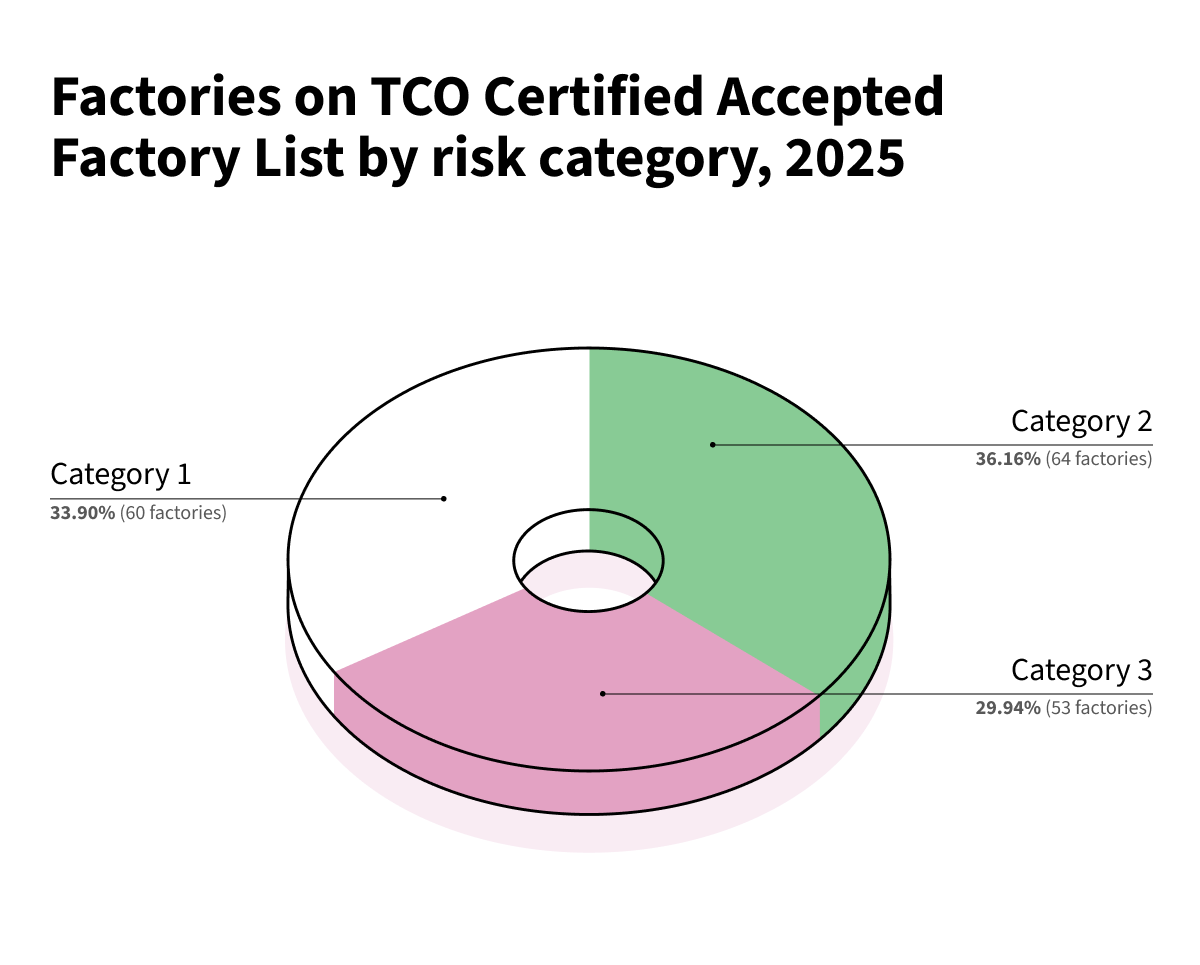
At the end of 2025, 177 final assembly and display panel factories were listed on TCO Certified Accepted Factory List, meaning they were approved to manufacture products certified according to TCO Certified. All factories on the list are regularly inspected and risk categorized. The risk level determines how often they are inspected. Of the listed factories, two-thirds have made enough progress to move to the lower-risk categories 2 or 3.
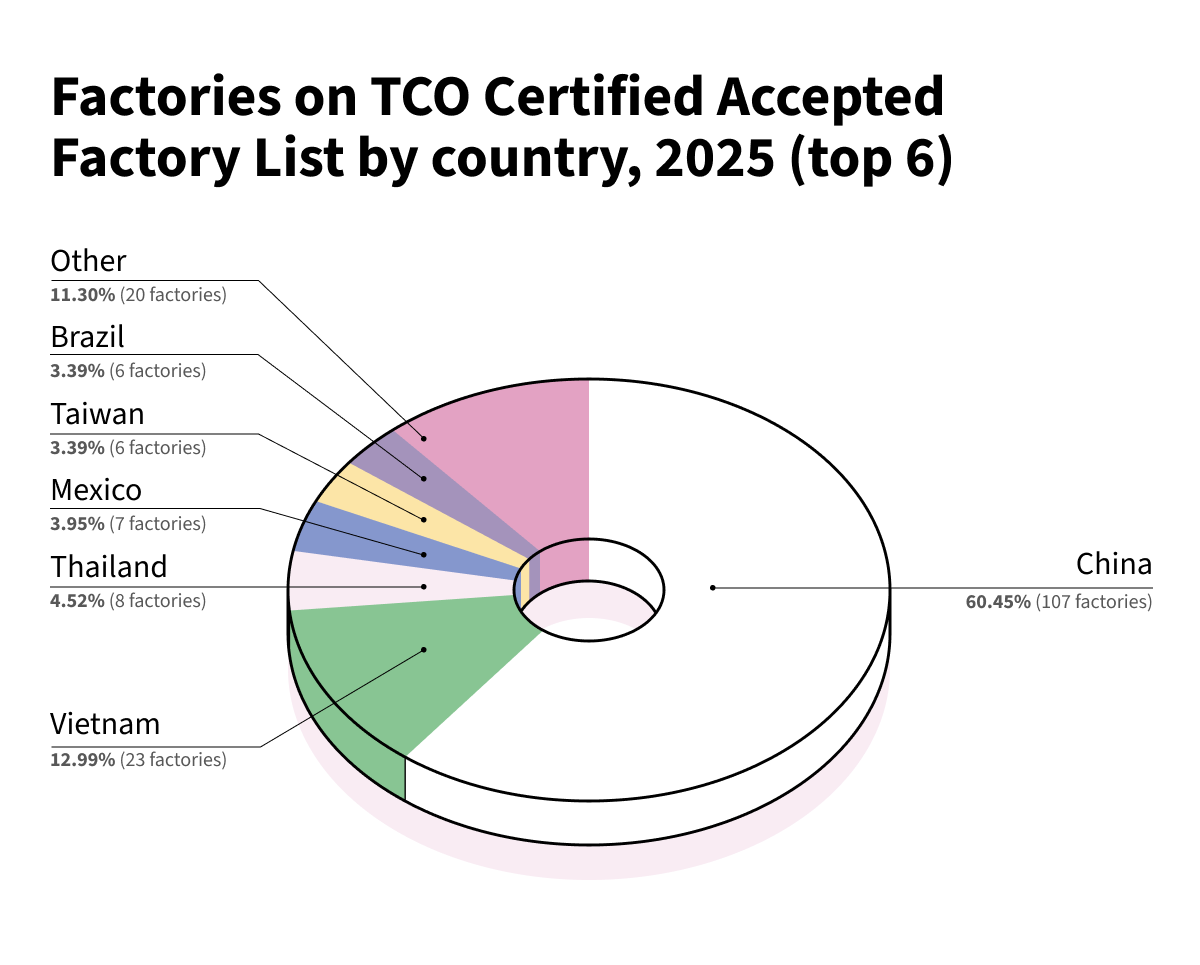
Manufacturing was geographically concentrated. Of the 177 factories, 89% were located in six countries: China, Vietnam, Thailand, Mexico, Taiwan, and Brazil. China alone accounted for 107 factories.
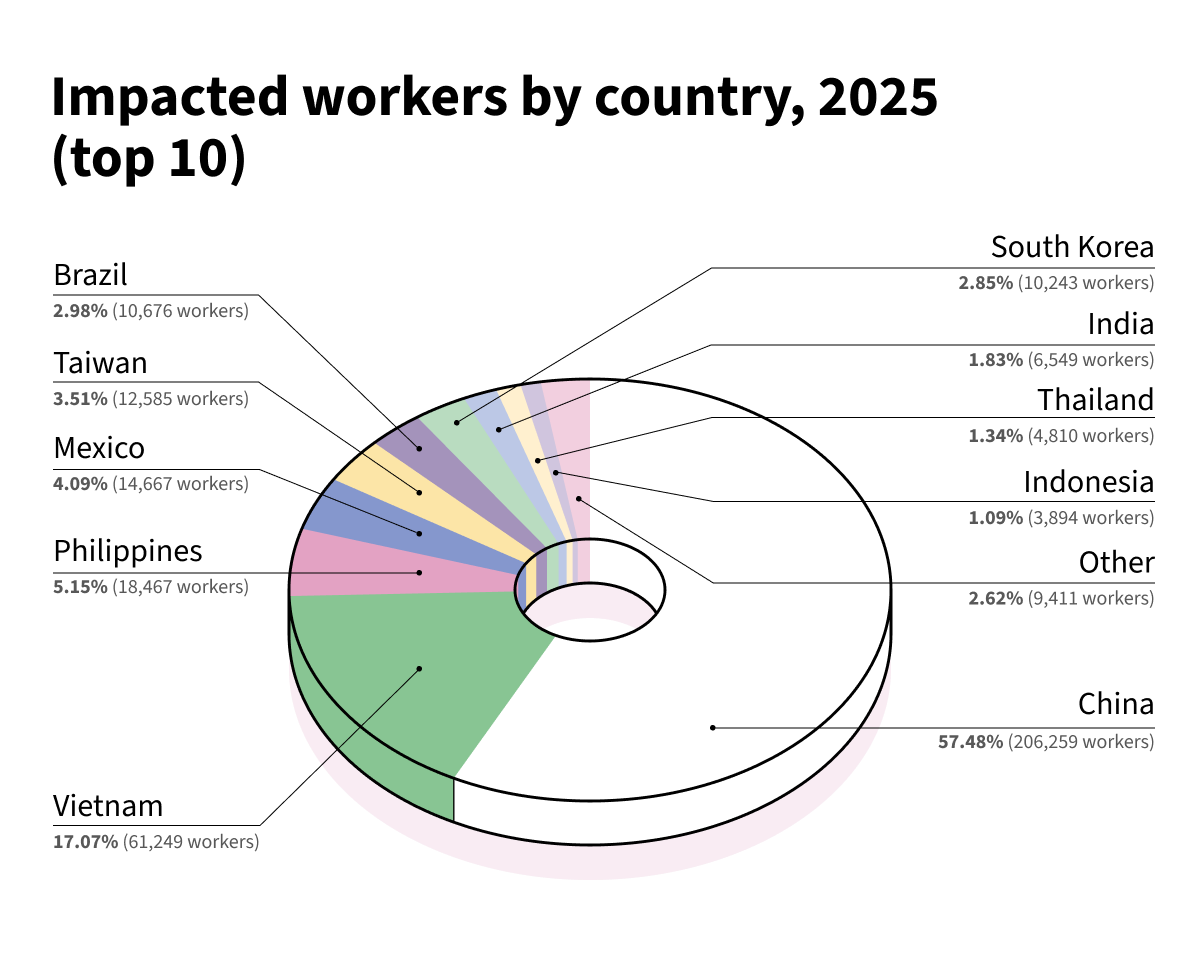
Together, the 177 factories employed 358,800 workers. Around 97% of these workers were located in ten countries, most of them in Asia. China and Vietnam accounted for the largest shares.
Factory verification is carried out continuously. During 2025, 109 factory audit reports were received, including initial audits, closure audits, and spot checks. The combination of factory mapping, risk categorization, independent verification, and follow-up creates transparency and supports continuous improvement in working conditions at factories manufacturing certified products.
INTRODUCTION
Mapping a complex supply chain
IT products have complex supply chains, with many suppliers spread across several continents. A typical computer can involve hundreds of processes and companies, spanning raw material extraction and material production to component manufacturing and final assembly.
Accessing even basic information about these supply chains can be difficult. It is not always clear where products are manufactured, which factories are involved, how many workers are affected, or what working conditions are like. This lack of transparency makes it more difficult to identify risks, set relevant requirements, and monitor progress.
Since 1999, TCO Certified has included mandatory requirements for supply chain responsibility. Mapping factories and suppliers is a key part of the verification process included in the certification, helping to identify risks, target follow-up activities, and monitor improvements throughout the supply chain.
Mandatory criteria improve social conditions
With TCO Certified, compliance with all criteria is mandatory and independently verified for all certified products and their supply chains. Suppliers must comply with criteria covering areas such as labor rights, health and safety, and ILO core conventions. Corrective action plans and follow-up are used to address identified problems and ensure that improvements are made.
Our supply chain criteria help buyers identify IT products that are responsibly manufactured, while directly impacting factory conditions of thousands of factory workers. By sourcing certified products, purchasers help ensure IT brands are held accountable for continuously improving social conditions within their supply chains.
TCO Certified Accepted Factory List
Before a final assembly or display panel factory can manufacture certified products, it must be listed on TCO Certified Accepted Factory List. An independent RBA-VAP or SA8000 audit is conducted within 12 months, and the factory is assigned a risk category based on audit results and ongoing performance.
Follow-up ensures that non-conformities are corrected within defined timeframes. The audit frequency varies between 18 and 24 months, depending on the factory’s risk category.
IT brands can use TCO Certified Accepted Factory List to select lower-risk production sites. This creates a business incentive for factory owners to prioritize sustainability improvements. High-risk factories must show sufficient progress to qualify for a lower risk categorization within 18 months of joining the program. Otherwise, they are removed from the list and can no longer manufacture certified products.
Why the TCO Certified system works
Since beginning the work in supply chain responsibility, we have observed several factors that are key to the success of this system.
Supply chain criteria in TCO Certified
OUTCOMES
Supply chain verification in numbers
This section presents key facts from our supply chain verification work, based on data from the end of calendar year 2025. The findings are organized into three areas: factories, audits and workers. Together, the data provide a snapshot of the final assembly and display panel factories involved in manufacturing certified products, the number of workers employed at these sites, and factory audits carried out to verify compliance with TCO Certified.
Section A
The factories behind certified products
Factories that manufacture certified products are located across several regions of the world. Most are not owned by IT brands, but are independent suppliers that manufacture products for several brands at the same time.
177 factories were listed on TCO Certified Accepted Factory List
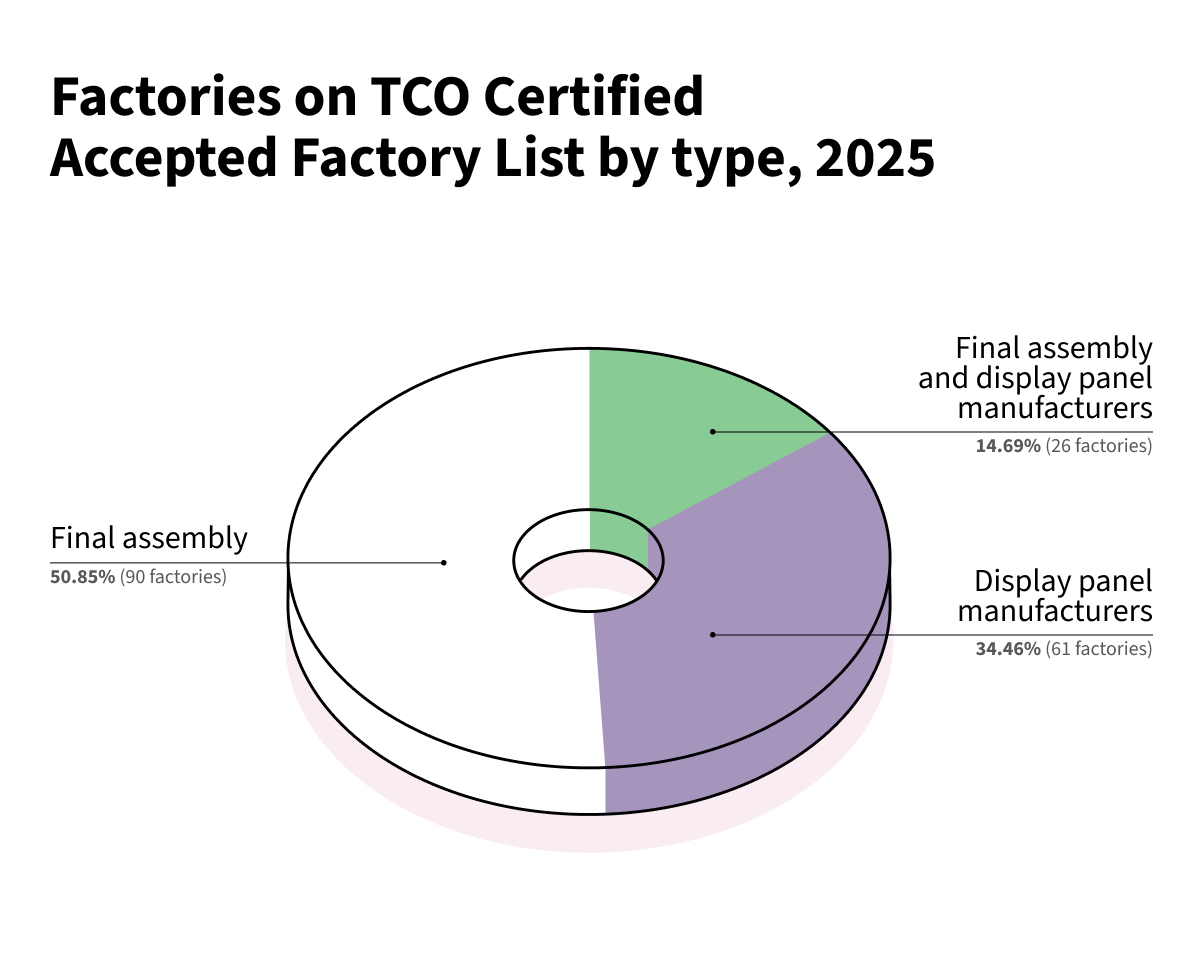
At the end of 2025, 177 factories were listed on TCO Certified Accepted Factory List. This number includes both final assembly and display panel manufacturing sites. Several factories carry out both display panel manufacturing and final assembly at the same site.
This may appear to be a relatively limited number of factories, but these are increasingly being shared among IT brands. TCO Certified Accepted Factory List has helped steer demand toward better-performing factories, allowing improvements to benefit the supplier and multiple brands.
Two-thirds have achieved a lower risk category
All factories enter TCO Certified Accepted Factory List as category 1. The data shows that of the 177 factories listed, approximately two-thirds have achieved and maintained enough progress to move to the lower-risk categories 2 or 3. This shows how this system encourages and rewards sustained improvement.
89% of factories were spread across 6 countries
Of the 177 factories on TCO Certified Accepted Factory List at the end of 2025, 157 sites (89%) were located in 6 countries: China, Vietnam, Thailand, Mexico, Taiwan, and Brazil. Manufacturing remains geographically concentrated, with China’s large share partly driven by the concentration of display panel manufacturing there. Vietnam and Thailand are also becoming important locations for technology manufacturing. Interestingly, several countries with large, cost-competitive manufacturing workforces remain less represented. Looking further into the supply chain tiers, the concentration in China becomes even greater.
Section B
Factory audits
Factory verification is carried out continuously as part of the TCO Certified system. Factories that are new to TCO Certified Accepted Factory List undergo an initial audit, followed by regular audits. The audit frequency is linked to the factory’s risk category, meaning that higher-risk factories are reviewed more often.
Any non-conformities identified during an audit must be corrected. The factory must submit a corrective action plan describing how the issues will be addressed, and a closure audit is then carried out to verify that the required improvements have been made. Spot checks are also conducted at selected factories.
109 audit reports in 2025
In 2025, 109 factory audit reports were received, representing a high level of audit activity compared with the number of factories in the system. Display panel factories were added to TCO Certified Accepted Factory List in December 2024, contributing to a higher number of reports than usual. The total number of audits varies from year to year, depending on factors such as factory risk categories and the number of new factories entering the system.
Section C
Impacted workers
Workers at factories on TCO Certified Accepted Factory List are directly impacted by the supply chain framework in TCO Certified. This impact is achieved through comprehensive supply chain criteria and ongoing independent oversight of factories by accredited, independent verifiers specializing in social and environmental responsibility. Factories are also required to submit key data regularly. These measures are specifically designed to protect and improve working conditions.
358,800 workers directly impacted
At the end of 2025, the 177 factories on TCO Certified Accepted Factory List employed more than 358,800 workers. They are all covered by essential labor protections, including requirements related to core ILO and UN conventions on forced labor and child labor, as well as worker health and safety and working hours.
In addition, all IT brands with factories on the list must comply with TCO Certified criteria covering anti-bribery management systems, responsible mineral sourcing, environmental and energy management systems, and safer substances.
97% of workers located in 10 countries
Of the 358,800 workers employed by factories on TCO Certified Accepted Factory List at the end of 2025, 97% were located in 10 countries. The impact of TCO Certified can also extend beyond these workers and factories. When workers understand their rights and what they should expect from an employer, they can carry this knowledge with them when they change jobs, helping spread awareness of responsible working practices across the wider manufacturing communities.
FUTURE
The next step: Driving progress further up the supply chain
TCO Certified’s approach to driving sustainability in the supply chain has been developed and refined over nearly three decades. The next step is to extend this system to more parts of the supply chain, helping reduce environmental risks and improve working conditions for hundreds of thousands more people.
In practice, this means creating workplaces where people can earn a decent living without relying on excessive overtime, where working hours are legal and predictable, and where workers can raise concerns through effective representation and dialogue with management. Ultimately, the goal is to make respect for workers’ rights part of everyday management, so improvements are sustained over time and benefit everyone in the factory.
What it means for IT purchasers
For IT purchasers, extending the system further into the supply chain means greater opportunities to address social and environmental risks through procurement. More suppliers will be covered by comprehensive supply chain criteria, independent verification, and ongoing follow-up, reducing the need for purchasers to investigate and verify complex supply chain issues on their own.
By requiring TCO Certified and choosing certified products, purchasers can also add their demand to that of other organizations. Together, this creates stronger incentives for IT brands and suppliers to improve working conditions, reduce environmental risks, and maintain progress over time.